
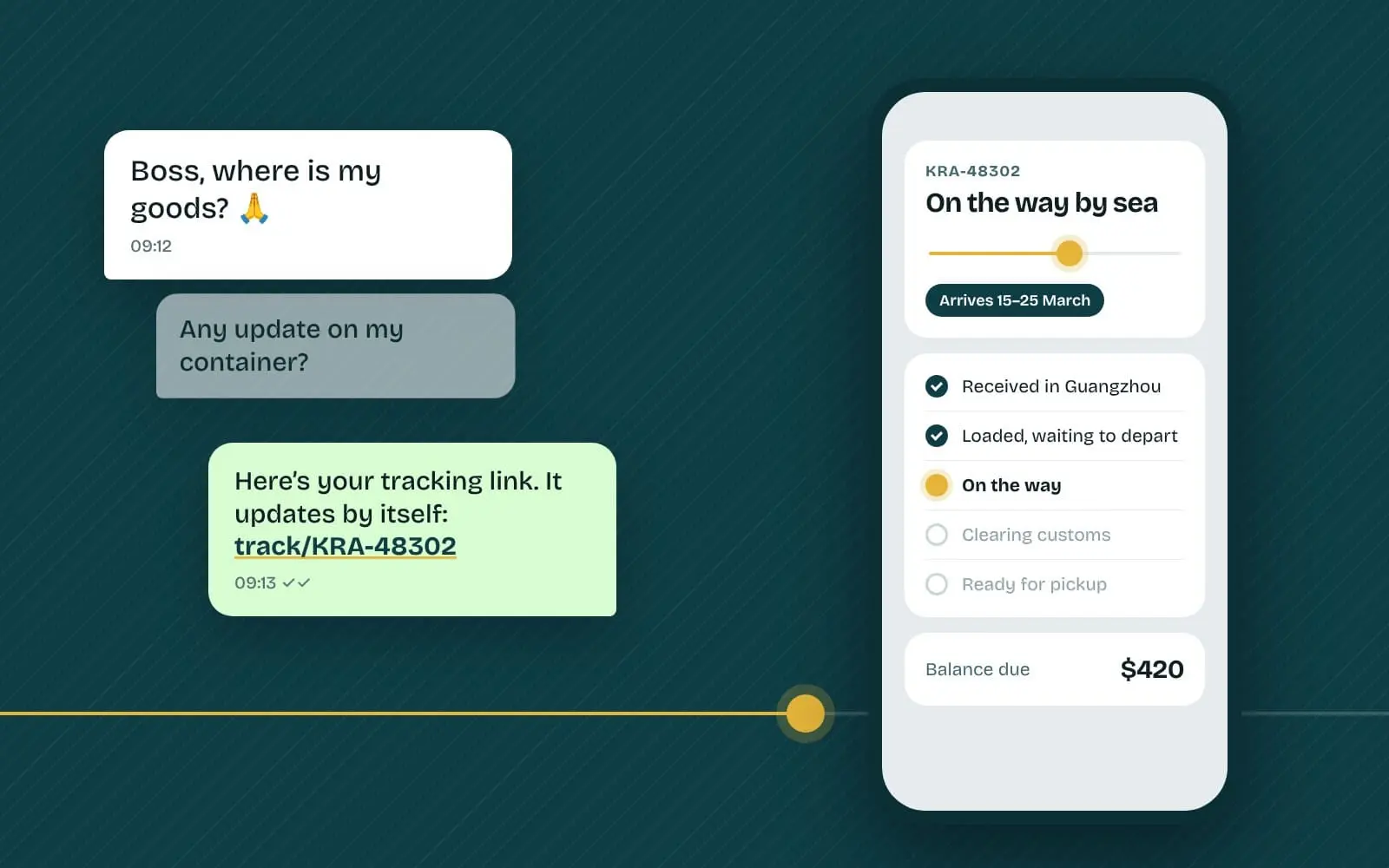
If you run a forwarding business between China and Africa, you know this message: “Boss, where is my goods?” It comes on WhatsApp, often several times for the same shipment, and every answer means stopping what you are doing, finding the carton list, checking with the warehouse and typing a reply.
The customer is not being difficult. They paid, their money is in a container somewhere, and they cannot see anything. The fix is not faster replies. It is giving them something to look at.
Why the questions never stop
Customers ask for three reasons, and each one has a different fix:
- They don’t know the stage. “It has left” means nothing if they don’t know whether it left the warehouse, the port or the country.
- They don’t know what happens next. A shipment that sits at the port for a week looks lost if nobody said that is normal.
- The last update was too long ago. After about a week of silence, most customers will message you, even if nothing has changed.
What to show on every shipment
Keep it short. Customers don’t need container numbers or vessel schedules. They need to know where it is, when it arrives and what they owe.
| Show this | Why it matters |
|---|---|
| Reference number | So you both talk about the same shipment |
| Current stage, in plain words | “At our Guangzhou warehouse” is clearer than “RCVD” |
| Expected arrival as a range | “15–25 March” is honest; a single date sets you up to miss it |
| What happens next | Stops the “is it stuck?” messages |
| Balance due | Avoids surprises when they come to collect |
Use stages your customers understand
Most shipments from China pass through the same handful of stages. Name them the same way every time, so customers learn them:
- Received at our warehouse in China
- Loaded, waiting to depart
- On the way (sea or air)
- Arrived, clearing customs
- Ready for pickup or delivery
- Delivered
Six stages are enough. More detail usually creates more questions, not fewer.
Send the update before they ask
The cheapest message is the one you send once to everyone. When a container departs or arrives, tell every customer in it at the same time, with a short message and a tracking link. One update to forty customers takes less time than forty separate replies.
A good rule: no customer should go more than seven days without hearing from you while their goods are moving.
How to start this week
- Write down your six stages and the words you will use for each.
- Pick your ten most active customers and send each of them their shipment’s stage and expected arrival.
- When the next container moves, send one update to everyone in it.
- After two weeks, count how many “where is my goods” messages you received compared to before.
You can do all of this with a spreadsheet and WhatsApp. It gets tiring once you have more than a few dozen active shipments, and that is where a tracking system helps: each customer gets a link or an app that always shows the latest stage, and you update a whole container in one step. If you’d like to see how that looks with your own routes, book a short demo.